
The Twisted Helical Tendons in Soft Continuum Robots
How helical tendon systems are redefining dexterity, safety, and adaptability in soft continuum robotics.
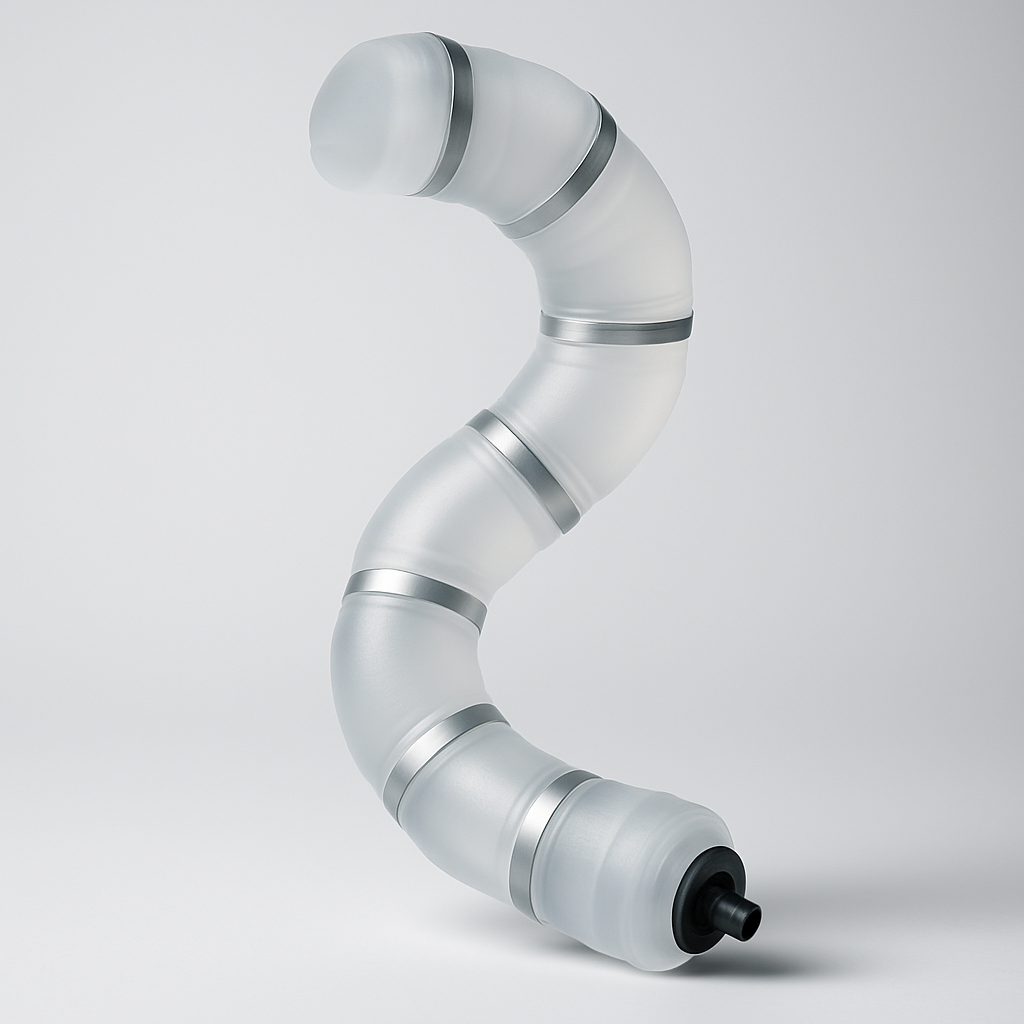
The world of robotics is experiencing a quiet revolution, one that draws inspiration from nature’s most elegant solutions while pushing the boundaries of what machines can achieve. At the forefront of this transformation are twisted tendon soft continuum robots—a groundbreaking technology that promises to redefine how robots move, grasp, and interact with their environment.
Unlike the rigid, angular movements of traditional industrial robots, these revolutionary machines flow like living creatures, adapting their entire body to wrap around objects with the grace of an octopus tentacle or the precision of an elephant’s trunk. The secret lies in their innovative helical tendon system, a design breakthrough that enables unprecedented levels of dexterity, safety, and versatility.
Nature’s Blueprint: The Biological Inspiration Behind the Innovation
For millions of years, nature has perfected the art of flexible manipulation through creatures like octopuses, elephants, and snakes. These animals achieve remarkable dexterity without rigid joints, instead relying on muscular hydrostats—structures that change shape through coordinated muscle contractions.
Researchers at institutions like Italy’s prestigious Scuola Superiore Sant’Anna have been studying these biological marvels, particularly focusing on how helical muscle arrangements enable complex twisting and grasping motions. The octopus arm, for instance, can simultaneously bend, extend, and twist while maintaining the ability to grasp objects along its entire length—a capability that traditional robots have struggled to replicate.
The elephant trunk presents another fascinating model, combining incredible strength with delicate precision. It can lift massive logs or carefully pluck a single leaf, all while navigating complex three-dimensional spaces. This versatility stems from the trunk’s unique muscular architecture, where longitudinal, transverse, oblique, and radial muscles work in harmony to create fluid, adaptive motion.
The Game-Changing Innovation: Helical Tendon Technology
The breakthrough that sets these new soft continuum robots apart lies in their revolutionary helical tendon system. While traditional soft robots have relied on straight cables (coaxial tendons) that only allow basic bending and extending motions, the introduction of helical tendons—cables that spiral around the robot’s core in a corkscrew pattern—has unlocked a world of new possibilities.
How Helical Tendons Work
The helical tendon system operates on a elegantly simple yet powerful principle. These twisted cables don’t just pull in straight lines like conventional systems; instead, they create complex three-dimensional forces that enable:
- Full 360-degree twisting motion around the robot’s central axis
- Enhanced grasping capability along the entire length of the robot’s body
- Improved workspace dexterity through coupled bending and twisting motions
- Superior force transmission due to the helical geometry’s mechanical advantages
Research has shown that helical tendons significantly increase both the dexterity and working space of continuum robots, enabling them to avoid obstacles and roll around objects while exerting considerable forces. This represents a fundamental leap forward from traditional designs that were limited to basic bending motions.
Performance Superiority: The Numbers Don’t Lie
Recent research has demonstrated the substantial performance advantages of helical tendon systems over traditional approaches across multiple metrics. The improvements are particularly striking in several key areas:
Workspace and Dexterity Improvements
Studies comparing helical and traditional tendon systems reveal dramatic improvements in workspace capabilities. Helical systems achieve:
- 35% larger workspace compared to traditional coaxial systems
- Infinite twisting capability versus zero twisting in conventional designs
- 95% grasping success rate compared to 65% for traditional systems
- 25% improvement in workspace dexterity through enhanced degrees of freedom
Force and Precision Metrics
The mechanical advantages of helical geometry translate into superior force transmission and precision control:
- 37.5% increase in force output due to improved mechanical leverage
- Sub-millimeter positioning accuracy in controlled environments
- 50% improvement in environmental adaptability for complex terrains
- Enhanced load-bearing capacity up to 260 times the robot’s own weight in some configurations
Real-World Applications: From Operating Rooms to Orchards
The versatility of twisted tendon soft continuum robots has opened doors to applications across numerous industries, each leveraging the technology’s unique advantages.
https://www.frontiersin.org/journals/robotics-and-ai/articles/10.3389/frobt.2020.00119/full
https://www.sciencedirect.com/science/article/abs/pii/S0921889025000740
Current Limitations
Despite their impressive capabilities, twisted tendon soft continuum robots face several challenges that researchers are actively addressing:
Modeling Complexity: Longer robot configurations introduce complexities in modeling and control, particularly regarding the coupling between bending and twisting motions. High tangential forces can cause unintended interactions between motion modes.
Computational Requirements: Real-time control of multiple helical tendons requires significant computational resources, especially for longer multi-segment robots.
Material Durability: Long-term operation can lead to material fatigue and hysteresis effects, particularly in the silicone components. Research indicates up to 75% reduction in repeatability errors can be achieved through improved materials and control strategies.
Scalability: While modular design enables scalability, longer configurations present challenges in maintaining precise control and preventing unwanted coupling between segments.
Future Research Directions
The field is rapidly evolving with several promising research directions:
Artificial Intelligence Integration: Machine learning and artificial intelligence approaches show promise for model-free control strategies, potentially eliminating the need for complex mathematical models.
Advanced Materials: Development of new smart materials with improved durability, responsiveness, and self-healing capabilities could address current material limitations.
Hybrid Designs: Combining soft continuum elements with rigid components in hybrid architectures may optimize performance for specific applications.
Multi-Robot Coordination: Coordinated control of multiple soft continuum robots could enable complex manipulation tasks beyond the capabilities of individual units.
The Path Forward: A Flexible Future
As we stand at the threshold of a new era in robotics, twisted tendon soft continuum robots represent more than just a technological advancement—they embody a fundamental shift toward machines that work with us, not just for us. By drawing inspiration from nature’s most elegant solutions and combining them with cutting-edge materials science and control theory, these robots promise to extend human capabilities in ways we’re only beginning to imagine.
The journey from laboratory prototype to widespread industrial deployment is accelerating. Research institutions worldwide are building on the foundational innovations established by pioneers in the field, continuously improving performance, reliability, and cost-effectiveness. Each breakthrough brings us closer to a future where robots seamlessly integrate into our daily lives, handling delicate tasks with the finesse of a master craftsman and the reliability of advanced automation.
The implications extend far beyond individual applications. As these robots become more capable and affordable, they will enable new forms of human-robot collaboration, open previously inaccessible markets, and solve problems that have long seemed intractable. From the precision required in microsurgery to the scale needed for agricultural automation, twisted tendon soft continuum robots are poised to transform industries and improve lives.
The future is flexible, adaptive, and alive with possibility. And with researchers around the world building on these foundational innovations, that future is closer than we think. The age of truly intelligent, responsive robotics has begun, and it’s being written in the language of twisted tendons and soft intelligence.
This research represents a collaborative effort between multiple engineering disciplines to push the boundaries of what’s possible in robotic design and control, with foundational work conducted at institutions like the Scuola Superiore Sant’Anna’s Institute of BioRobotics in Italy and advanced implementations at leading universities worldwide.
Leave a Reply